Vincent Joseph Marinato OAM

Plaque Unveiling Gallery
Community Advocate
Michele and Rosaria Marinato
The Move to Watsons Bay
Tom and Bruna Marinato
Vince Marinato
Community Work
Preserving the Stories of Italo-Australian Life
Legacy and Recognition
Honours and Awards
Sources
Vincent Joseph Marinato OAM
1923 - 2009
Vince Marinato photographed with his father Thomas's scrapbook, c. 1990. Reproduced with the permission of the Marinato family.
A plaque commemorating Vincent Joseph Marinato was unveiled on 2 December 2025 by Councillor Julian Parmegiani and Mark Marinato at 3 Marine Parade, Watsons Bay. The guest speaker was Vincent Marinato's son Mark Marinato, who also nominated Vincent for the plaque. A transcript of his speech is available.(PDF, 1012KB)
Plaque location
The plaque is located on the frontage of 3 Marine Parade, Watsons Bay.
View all plaques in Woollahra
Plaque Unveiling Gallery
Vince Marinato provided a dedicated and enduring community service to his beloved home of Watsons Bay and to the wider Woollahra LGA. He ensured the survival of local folklore and history as well as Italo-Australian heritage by fostering relationships and recording local historical and family information.
The story of Vince’s life and his association with Watsons Bay is intertwined with three generations of his family and the establishment of the family business on the Watsons Bay Wharf.
Michele and Rosaria Marinato
Vince’s connection to Watsons Bay begins with his grandparents Michele Berinato and his wife Rosaria, nee Ristuccia, who migrated to Australia from Salina, one of the Aeolian Islands north of Sicily, at the end of the 19th century. The name Marinato came about after a series of misspellings of Michele’s surname.
Michele Berinato, along with his four brothers left their home on the island of Salina, for America in the 1880s. On arrival in New York Michele’s surname was recorded as Mirinato, the first in a series of misspellings and the name Michele would take with him to Australia. The brothers worked on the construction of the Brooklyn Bridge for a number of years before Michele decided to return home.
Back on Salina, Michele bought a wagon with his savings and became a carter. He was introduced to Rosaria Ristuccia who he married in 1887. Soon after Michele and other Aeolian men were offered work in Australia at the mines of Broken Hill. After the work was completed, Michele took up the offer of remaining in Australia and headed to the Hawkesbury River. Michele worked as a fisherman and from the money he saved Rosaria was able to join him after emigrating from Salina.
By the last years of the century Michele and Rosaria had opened a fruit and vegetable shop in William Street, Woolloomooloo.[1] The couple had two children who survived to adulthood, a daughter Giovanna, known as Jenny, born in 1894, followed by a son Thomas Gaetano, known as Tom, born on 17 April 1904. After Tom's birth Michele and Rosaria opened another fruit and vegetable shop in a new development at Rose Bay on New South Head Road, between Dover Road and Newcastle Street. The family moved to an apartment behind the shop and sold produce from the Sydney markets and the nearby Chinese market gardens.[2]
The Move to Watsons Bay
The Marinatos' long association with Watsons Bay began in 1904 with Michele and Rosaria's decision to open a shop and refreshment rooms on Watsons Bay Wharf. Looking to move to Watsons Bay and seeing the potential in starting a new business on the busy ferry wharf, in 1904 Michele and Rosaria took up a lease from the Sydney Harbour Trust for a ferry waiting shed (placed adjacent to the original ferry waiting shed) at the head of the wharf. It was at this time that the Marinato name came about due to another misspelling when signing the lease.[3] Conditions of the lease stipulated long hours – from seven a.m., an hour before the first ferry left Watsons Bay, until after the last ferry docked at midnight – even as the family continued to run the Rose Bay fruit shop. The rent was two shillings and sixpence a week and the Marinatos were liable for all costs for any renovations and installations. With the help of local fisherman and boatshed owner Harold (Nugget) Newton the building was transformed for opening, painted blue with a kookaburra gas stove, a counter, and tables and chairs.
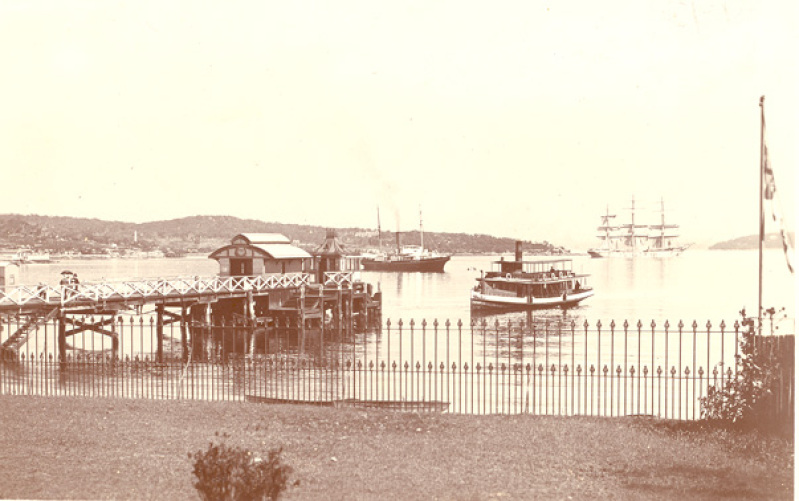
The refreshment rooms and shop on Watsons Bay Wharf, c. 1905. Woollahra Libraries Digital Archive pf000193
With the rebuilding of the Watsons Bay wharf and waiting shed in 1910 the refreshment rooms and shop were relocated further along the jetty towards the shore.[4]
By the mid-1920s in order to accommodate the ever-expanding business a larger purpose-built weatherboard building was constructed at the approach to the wharf on Marine Parade. The shop was placed at the front of the building facing the roadway, the kitchen behind with the restaurant opening onto the wharf overlooking the north side of the bay. Operating initially as the Watsons Bay Tea Rooms, it was later renamed the Continental Tea Gardens.
Michele and Rosaria worked hard to establish their business in Watsons Bay, serving traditional fare as well as introducing new ideas. Tourists, day trippers and locals were served scones, tea, coffee and cocoa, with hot water, confectionary and fruit also on offer. Rosaria introduced traditionally cooked calamari, and they were the first in Sydney to operate a soda fountain, sent from family in America in 1910.
The opening of the refreshment rooms and shop marked not only the beginning of the Marinato family’s life in Watsons Bay but also an early Italian presence in the restaurant trade in Australia. The business established by Michele and Rosaria continued for over sixty years and was operated by three generations of the Marinato family.
In 1914 Michele and Rosaria purchased a parcel of land from the sale of the subdivision of the Harbour View Estate at Watsons Bay.[5] The following year in March, Michele and Rosaria were given approval by Vaucluse Council to erect a brick cottage on their waterfront allotment which was to be built by the Intercolonial Investment Land & Building Company.[6] The house at 3 Marine Parade, named Rosaria became the home of three generations of the Marinato family. The family traditionally opened their home to family and friends and offered sponsorship and hospitality to Italians who came to Australia for work.[7]
 The family home at 3 Marine Parade, 1982. Watsons Bay Field Survey, Woollahra Libraries Digital Archive
Michele and Rosaria became highly valued members of the Watsons Bay community and Vince Marinato recalled that on his grandfather's death on 3 September 1931, 'the Vaucluse Council offices closed for the day, so highly was he regarded in the Bay' while Council's trucks were 'draped around the sides with black cloth and forma placed in the back for seating those Council employees and their families who wished to join in the funeral procession'.[8] Michele was buried in the family vault at South Head Cemetery under the name 'Mirinato', the funeral procession extending from 'Our Lady Star of the Sea Church almost to the Cemetery'.[9] Vince remembered him as 'a small thickset man with a grey level head who never raised his voice except when he laughed or talked to J.J. He had a prodigious sense of humour ... and he was very kind to me...'.[10]
Rosaria died on 7 June 1942. For Vince she stood out in his memory 'like nothing else. She was a straight backed, solid little woman; she swam like a fish and walked like an empress. Her word was law. On the other hand her generosity was legendary ...'.[11]
Tom and Bruna Marinato
The running of the business was a family affair and from a very young age Vince's father Tom helped in the shop at Watsons Bay - sweeping the floors at age 6, and as a teenager working at the Rose Bay shop.[12]
On 17 January 1923 Tom married Bruna Domenici, from Viareggio, a seaside town in Tuscany, at Our Lady Star of the Sea Church at Watsons Bay. Tom and Bruna moved into the house at 3 Marine Parade and worked alongside Michele and Rosaria in the refreshment rooms.
One of Tom’s great loves was film and as well as working in the family business he was a pioneering filmmaker who produced several films and newsreels during the 1920s and 1930s. He made an important contribution to early filmmaking in Australia, some of his films being ‘My First Big Ship’, ‘Sydney’s Darlings’, ‘Hunting the Octopus’ and ‘Patonga Waterlilies’. ‘Sydney’s Darlings’, the first film Tom directed and released in 1926, was a silent movie set in the world of yachting on Sydney Harbour, featuring 18 footers, and the crew and their boat ‘Sydney’s Darling’.
Tom Marinato's new picture 'Sydney's Darlings' is nearing completion ... This sporting movie ... has a clever plot, with thrills and humour and the photography is an excellent sample of the cameraman's art.[13]
Tom’s work was often based on local and domestic events such as ‘The Guiding light of South Head’, a newsreel made in 1930 in conjunction with Australasian Films, which was centred on the workings of the mirrors in the Macquarie Lighthouse.
‘My First Big Ship’, a documentary film about the pilot service in Sydney Harbour which Tom wrote, directed and acted in, was the first of a number of films made with foremost cinematographer of the time Walter Sully, in 1932:
Mr. Walter Sully and Mr. Thomas Marinato have accomplished a fine piece of pioneering film work in "My First Big Ship", talkie travelogue of Sydney Harbour. This is a delightful piece of work, with Mr. Marinato, who wrote the story, as one of the pilots of the Captain Cook, and the detail is excellent. Mr. Sully's camera has reproduced the magic of Sydney Harbour, beginning with old Watson's Bay, and ending as the Oronsay is safely at Woollomooloo. The Orient S.N. Co. and the pilot service co-operated with the makers of the travelogue, and the result is a little picture that will charm Australians. 'My First Big Ship" should be an excellent beginning for the export of typically Australian art pictures.[14]
The making of ‘My First Big Ship’ led to the family home becoming ‘an unofficial clubhouse for the harbour pilots’ and the Marinatos were ‘presented with the flag of the Sydney Harbour Trust … in recognition of the association’.[15] The film is held at the National Film and Sound Archive of Australia.[16]
After Michele’s death Tom had less time to spend on film making as he, Bruna and Rosaria devoted their days to the running of the Continental Tea Gardens. The Marinato tradition of innovation and enterprise continued with the move to the new tea rooms, the family pioneering outdoor dining, installing display fish tanks and popularising gelato. Confectionary was always in favour and the main window of the shop ‘was used for a chocolate display with plates spread with various kinds of confections’. Chocolates were initially imported from England until Cadbury’s started making chocolate in Australia in the 1920s. Vince recalled the company then ‘made a feature of marketing an especially large box of chocolates … with the coloured wrappings placed so as to depict an Australian scene. One depicting Watsons Bay was raffled at Christmas, the proceeds being used to pay for an instrumental quartet which played ‘Palm Court’ style music outside the Shop on weekends’.[17] Later the shop was one of the first to stock Cadbury's introduction in 1940 of blocks of chocolate.
 Continental Tea Gardens, Watsons Bay Wharf, 1930s. Woollahra Libraries Digital Archive pf008404
The family navigated the difficult depression years through goodwill, determination and hard work. While still running the shop and refreshment rooms Tom sold prawns, lobsters and seafood door to door while Bruna ‘built up a steady trade in Devonshire Teas, with her home-made scones, strawberry jam and watercress’, which Vince noted that not even the Prime Minister of the day Joe Lyons and wife Enid could resist.[18]
The many and varied attractions around the Bay and on the Wharf had always been good for business, not least Big Game Fishing – popularised in the 1930s by American author Zane Grey who fished for sharks outside The Heads while based at Watsons Bay. Fishermen would weigh their catch from scales mounted off the wharf with any records reported in the press. Tom and Vince made the most of this enthusiasm broadcasting over ‘two huge loudspeakers set up outside – news of boats, sharks and expected arrival back times’.[19] They advertised the Tea Gardens as being ‘At the Service of all fishermen’ with ‘fishing bait supplied’ and ‘fishing parties catered for in first-class manner’.[20]
In his later years Tom devoted much of his time to organising his memoirs, clippings, ephemera and photographs, producing a precious record of his family history, his life and his local and Italo-Australian community. The diary is held at the State Library of NSW.
Following the practice begun by Michele and Rosaria, Tom and Bruna worked hard not only for the success of their business but also for the Watsons Bay community and to support Italo-Australian relations. Tom, a popular identity of Watsons Bay, died on 29 April 1973 while Bruna died some years later on 22 April 1992. Vince remembered his mother as ‘loving, not terribly strict … she was never too busy to listen to me’ and his father as someone that ‘everyone loved and respected’ …and that ‘he would have to be the greatest and most endearing friend that I ever had’.[21]
Vince Marinato
On 10 March 1923 the first of Tom and Bruna’s children, Vince - Vincent (Virgilio) Joseph Marinato, was born at the family home in Marine Parade. His birth was followed by that of his two brothers Tony (Anthony) and Michael.
From a young age Vince was expected to work at the ‘Shop’, particularly during busy periods such as school holidays, running errands and selling sweets from the counter or prawns from a basket outside the shop. There was little time for leisure but Vince enjoyed fishing, mini golf at the Palace Hotel (later the Watsons Bay Hotel) and movies at the local cinema. Vince attended the local Catholic primary school, Our Lady Star of the Sea, at Watsons Bay and later as a secondary student the Marist Brothers High School in Darlinghurst.
 View of Watsons Bay in the 1920s. Woollahra Digital Archive pf005167
After leaving school Vince worked in the family business until the outbreak of World War II when on 16 October 1941 he enlisted in the Australian Army at Waverley Park, Bondi Junction. As Vince was not yet 19, he commenced his war service in the Citizen Military Forces on 31 January 1942 until the following year when he transferred to the Australian Infantry Forces on 23 February 1943. Vince served in New Guinea as part of the 2/7th Advanced Workshops Australian Electrical and Mechanical Engineers before being discharged on 5 August 1946.[22]
After his return from war service Vince joined Tom and Bruna in the running of the Tea Gardens and in 1947 the business became Thomas Marinato and Son. By the 1950s Tom and Vince had expanded the menu from the basic fare of the early days and the spaghetti and meat pies of the pre-war years, to include a wider range of seafood (usually fried and served with chips) such as lobster and prawns. The serving of potato chips in containers was another family innovation in the late 1950s. During the 1960s refrigerated food cabinets stocking a wide variety of foods were added as the restaurant and take away food business became increasingly busy.
Since the early years the restaurant had attracted a large clientele and was popular with Sydneysiders and overseas visitors, politicians, celebrities and locals alike. Notable customers included, among others, Billy Hughes, Banjo Paterson and Joe and Enid Lyons, Zane Grey, Alfred Hitchcock, Ava Gardner and Liberace.
The Bay had long been a popular location for artists and from 1955 to 1963 the Wharf was used as an outdoor exhibition space which supported artists and brought custom to the refreshment rooms. The Watsons Bay Wharf Art Exhibition, of which Vince’s brother Tony was president, organised displays to be hung along the Wharf as well as inside the restaurant, with works including well known artists such as Norman Lindsay and Russell Drysdale and local artists such as Pixie O’Harris and Douglas Pratt.[23]
In 1952 Vince married Angela Bernadette Caltabiano in Paddington and they had three children Tom (Thomas), Mark and Linda. The family lived at 11 Salisbury Street, Watsons Bay, built by Michele and Rosaria in the mid-1920s on land they had purchased from the sale of the Harbour View Estate in 1917.[24] The property ran behind the family home at 3 Marine Parade and was originally built as two semi-detached cottages known as The Flats. It was enlarged in 1938 with the addition of three flats and became known as Marina Flats.[25] In 1967 Vince and Angela purchased the neighbouring house at 9 Salisbury Street, where they lived before moving to the original Marinato home at 3 Marine Parade in the 1980s.[26] Vince and Angela then undertook renovations to Rosaria respecting the history and integrity of the original house. Rosaria remained the Marinato family home until it was sold in 2011.
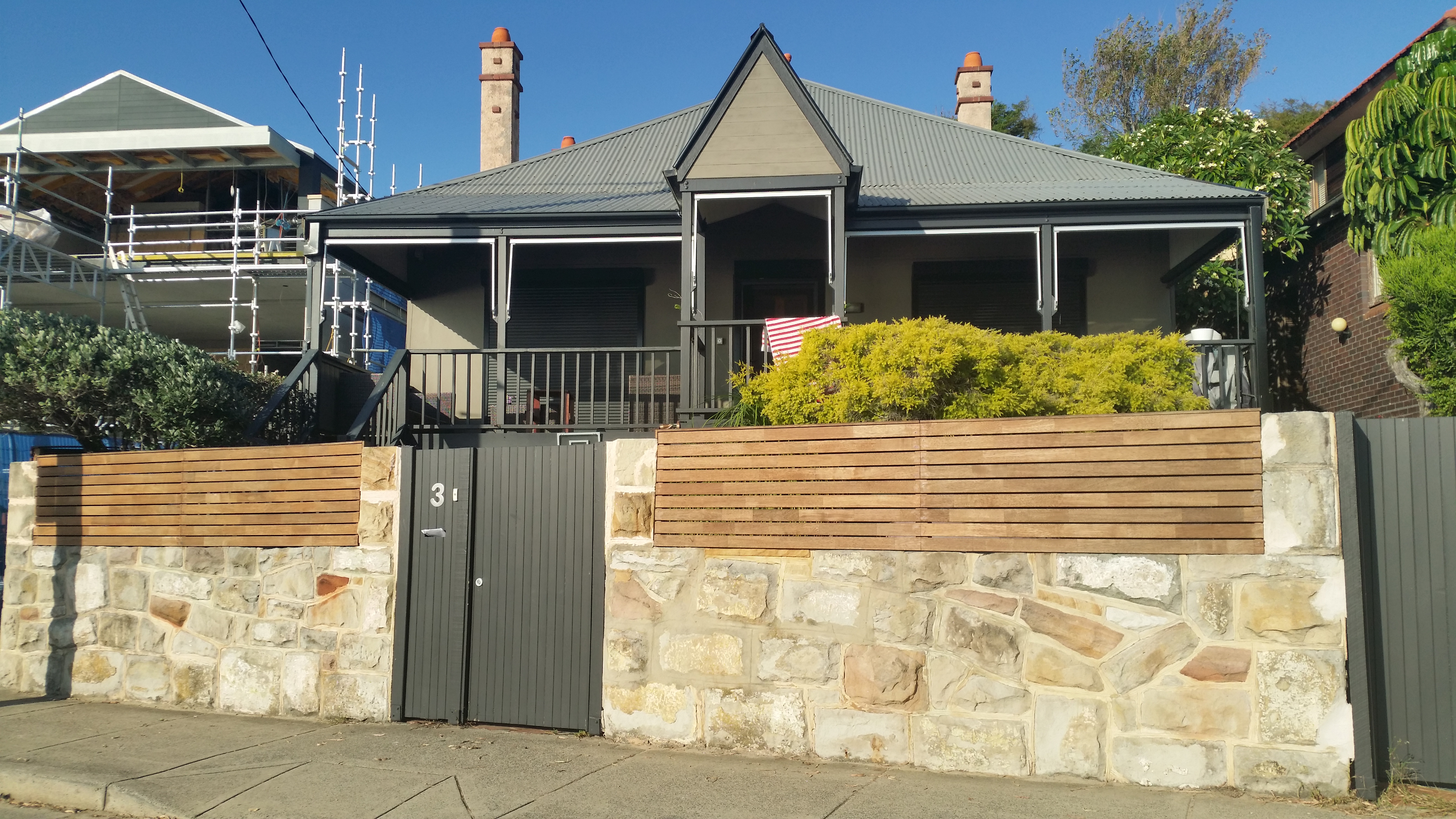 3 Marine Parade, Watsons Bay, 2018. Woollahra Libraries Digital Archive pf008165
Before her marriage Angela had worked at both Marinato shops, first at Rose Bay and then Watsons Bay, and she continued to work with Vince running the Continental Tea Gardens at Watsons Bay until the business was sold to the Doyle family, who operated the nearby Doyle’s restaurant, in 1968. The original shop and refreshment rooms were then rebuilt, becoming known as Doyles on the Wharf offering take away seafood.
Feeling in need of a change of scene after so many years running the shop and restaurant which he never felt ‘belonged to me – I belonged to the Shop – ever since I was old enough to look over the counter’, Vince purchased a hotel in the NSW country town of Forbes.[27] Vince ran the pub for three years before loneliness and homesickness and the news of his father’s poor health prompted him to sell up and return home to Watsons Bay.[28]
Vince and Angela then worked in a number of wholesale liquor licence ventures before their retirement in the mid-1980s. Vince was determined to honour the Marinato family tradition established by his grandparents of fostering Italo-Australian relations and serving the community, and he and Angela worked tirelessly to achieve this aim.
Vince was an active member of a number of community organisations including the Woollahra History and Heritage Society, the Watsons Bay Society, the Vaucluse Lions Club, and the Rose Bay RSL Club of which he was a director, and for some time president of the sub-branch. He was an occasional contributor to the Baylief, published by the Watsons Bay Society, and contributed his wartime reminiscences to the Woollahra History and Heritage Society’s 1995 publication As I remember: recollections of World War II.
Like his father Tom, Vince loved Watsons Bay and the people who lived and worked there as recorded affectionately in his book The Shop on the Wharf. He was an enthusiastic and dedicated member of the local community, assisting with the organisation of the Watsons Bay Carols by Candlelight held annually at HMAS Watson and he acted as a supervisor for Clean-up Australia Day each year. He was co-ordinator of the 200th Anniversary of the South Head Signal Station held in 1990.
As part of the Bicentennial celebrations of 1988 Vince played a key role in the organisation of local events in particular the Vaucluse Bicentenary Regatta, Carnival and Game Fishing competition taking place at Watsons Bay. Over 300 sailing ships took part in the regatta and the carnival, held in Robertson Park, comprised a variety of celebrations with a special recognition of the Bay’s Portuguese heritage. Vince was the initiator of another bicentennial project to publish a guide to Watsons Bay’s historic sites in a series of walking tours. This project was brought to fruition by Bruce Crosson as the publication Watsons Bay: a walk back in time.
 Portuguese dancers at Robertson Park, Watsons Bay, part of the Australia's Bicentennial celebrations organised by Vince Marinato, 1988. Photograph: Bruce Crosson. Woollahra Libraries Digital Archive pf001337
Vince was keen to preserve the character and history of the local area. He was involved in successful campaigns to ensure the restoration of the Tingira Memorial Park at Rose Bay, dedicated to those who served on the HMAS Tingira, and the preservation and improvement of the Watsons Bay waterfront in particular the Watsons Bay Baths. In late 2008 he was still actively supporting a local campaign to have the last remaining lifeboat of the Sydney Harbour Service, the Alice Rawson, salvaged and returned to her original Watson’s Bay home.[29]
Preserving the Stories of Italo-Australian Life
In 1989, the State Library launched ‘The Italians in NSW’ project - a drive to deliver unique and irreplaceable documents demonstrating Australia’s Italian history into the safe-keeping of the State Library. The initiative was a joint venture between the State Library of New South Wales and The Italian Historical Society (NSW), working under the auspices of the Comitato Assistenza Italiani (Co.As.It) and with financial assistance from The Australian Multicultural Foundation.[30] The project recognised that beyond preserving these documents, their custody within a public collection made them accessible to the Italian community and the broader public
With the characteristic generosity of the Marinato family, Vince Marinato surrendered to this project a great family treasure – his father, Thomas Marinato’s diary and scrap book. Gifted in June 1990, early in the life of the program and well-publicised, the gesture was a perfect example to put before the State’s Italian community, to encourage other potential donors to participate in the scheme.
The handover of the book, at Vince Marinato’s home – fittingly the same house where Thomas compiled his album – is captured on photographs in Woollahra Library’s Digital Archive, attended by Dr Guido Scalici, the Italian Consul General, David Conolly MP representing Federal Parliament and State MP Franca Arena MP, whose career is associated with a strong record of parliamentary and community service in ethnic and multicultural Affairs.[31]
 Handing over of Thomas Marinato's diary to the State Library of NSW, 19190. L to R: Dr Guido Scalice, David Connolly MP, Franca Arena MP, Angela and Vince Marinato. Photograph: Bruce Crosson. Woollahra Libraries Digital Archive pf002066
Thomas Marinato’s diary, titled 'Walking Down Memory Lane, My Memoirs: Story and Illustrations' is described on the State Library catalogue as a family album, compiled 1968-1974. The catalogue summarises its rich contents and what they demonstrate:
[The album includes] correspondence, newscuttings, programmes and photographs. Family occasions and activities such as parties, weddings and small business ventures are recorded as part of the social history of Watsons Bay and its environs. Aspects of maritime life are also documented, including shipping, yachting regattas and fishing, where local fishermen mixed with celebrities like the American writer of westerns and big-game fisherman, Zane Grey.
As part of the donation, it was arranged that Woollahra Library would receive a microfilm of the contents, which is held in the Local History collection.
A year later, in June 1991 a plaque was unveiled at Watsons Bay on the former site of an old fig tree, locally known as the ‘Tree of Knowledge’, to commemorate the daily gatherings of fishermen around its broad trunk.[32] Reporting the event in the Baylief, contributor Bruce Crosson wrote that the source of information for the details on this plaque was Thomas Marinato’s Down Memory Lane – ‘a voluminous collection of historical and social comment on his [Marinato’s] times – first half of this century – and mostly dealing with Watsons Bay.’[33]
In 1996 Vince Marinato self-published The Shop on the wharf, a work of family and local history as well as a personal memoir. An invaluable resource for local, social and family historians his book captured his own reminiscences and observations on the family business in the context of the local and wider Italo-Australian communities.
Legacy and Recognition
Vince’s work for the community, in recording local history and in preserving and fostering Italo-Australian heritage was recognised with the award of the Medal of the Order of Australia on 26 January 2000 for ‘Service to the community of Watsons Bay, particularly in preserving the Italo-Australian heritage of the area by recording and documenting local history’. On receipt of the award Vince paid tribute to his family:
I feel I am the custodian of the award [and] that is is really for my grandparents who did such a wonderful job, as did my father and mother in Watsons Bay when the depression was on, and for my wife Angela'.[34]
Angela Marinato was presented with a Woollahra Citizenship Award in 2002 for her ‘long standing involvement with community activities in Watsons Bay and Rose Bay’.[35]
For his many years of tireless community service Vince was awarded the Centenary Medal in 2001 for ‘Service to the Watsons Bay community’.
A well respected and tireless supporter of his local community Vince died at his Watsons Bay home on 4 January 2009 aged 85. On his death Vince was the subject of a Woollahra Council mayoral minute noting that he was ‘an outstanding member of the Watsons Bay community’ and paying tribute to his ‘contribution to the Council and his local community’.[36] After many years of service to the community Angela died on 23 April 2015. Vince and Angela were buried in the Marinato family vault at South Head Cemetery and Vince is commemorated as ex-defence force personnel in the New South Wales Garden of Rememberance at Rookwood Cemetery.[37]
Vince Marinato was a well-known and popular character of Watsons Bay, and a great storyteller who held a deep love for his home and family. A generous, sociable man who showed a lasting and unwavering commitment to his community at Watsons Bay.
Honours and Awards
- In March 1994 Vince was awarded the inaugural Wentworth Courier Senior Citizens Award, initiated by the Eastern Suburbs Newspapers group to honour the contribution of a Senior from each of the areas covered by its publications.
- Awarded the Woollahra Citizens Award for outstanding community service over a lifetime spent in Watsons Bay in 1996.
- Awarded the Medal of the Order of Australia on 26 January 2000 for Service to the community of Watsons Bay, particularly in preserving the Italo-Australian heritage of the area by recording and documenting local history.[38]
- Awarded the Centenary Medal on 1 January 2001 for Service to the Watsons Bay Community.[39]
Sources
Andrighetti, Jim, ‘Patrimony on Parade: the collection, preservation and exhibition of the Italo-Australian documentary heritage at the State Library of NSW’, HIS Journal 2017.
Baylief: bulletin of the Watsons Bay Society Vol 1 No 10, Summer 1991 p. 4
Marinato, Vince, The Shop on the Wharf, 1996
Museums of History NSW
National Library of Australia
National Film and Sound Archive of Australia
NSW Births Deaths and Marriages
Reynolds, Anne, ‘A Short history of Italian cafes and restaurants in Sydney’, Modern Greek Studies Australia and New Zealand: a Journal for Greek Letters Vol. 10 2002, pp.136-155
State Library of NSW
TROVE
Woollahra Libraries Digital Archive
[1] Tobacco, cigar and cigarette licence issued in 1898 to Michael Mirinato of William Street Woolloomooloo NSW Govt. Gazette 11 Nov 1898, p. 8875 https://trove.nla.gov.au/newspaper/article/220970786/13874006
[2] Marinato, Vince, The Shop on the Wharf, 1996, p. 19 and 1909 Tomaccbo, cigar and cigarette licence to M. Mirinato [sic], New South Head Road, Rose Bay NSW Govt. Gazette 22 Sep 1909
[3] Marinato (1996), p. 29; the name Mirinato was still in use in certain official documents
[4] A replacement wharf and waiting shed were erected at Watsons Bay by the Sydney Harbour Trust in 1910, ‘Harbour Improvements’, The Sydney Morning Herald (NS : 1842 - 1954) 26 November 1910, p. 15 http://nla.gov.au/nla.news-article15190003 See image showing the refreshment rooms and new ferry waiting shed,1910, at Museums of History, State Records Collection, NRS-9856-2-151-7205 https://search.records.nsw.gov.au/permalink/f/1ebnd1l/ADLIB_RNSW115822684
[5] Lot 3, Cert of Title Vol. 2467 Fol. 42
[6] BA159/1915
[7] Vince Marinato in ‘Treasure Chest Full’, Wentworth Courier 7 Feb 1990, p. 16 (Local History research file Marinato Family)
[8] Ibid, p. 74
[9] Ibid, p. 37
[10] Marinato (1996), p. 137
[11] Marinato (1996), p. 137
[12] Marinato (1996), pp. 42-43
[13] ‘The Eighteen footers’, Referee (Sydney, NSW: 1886 – 1939,) 4 November 1925, p. 19. http://nla.gov.au/nla.news-article127568363
[14] ‘Street Scene’ ‘Magic of Sydney’, The Sun (Sydney, NSW: 1910 - 1954) 8 April 1932, p. 6 http://nla.gov.au/nla.news-article229890825
[15] Marinato (1996), p. 119
[16] ‘My First Big Ship’, National Film and Sound Archive of Australia, MY FIRST BIG SHIP - Search the Collection - National Film and Sound Archive
[17] Marinato (1996), p. 76 and Vince notes this would have been in the 1930s, p. 138
[18] Marinato (1996), p. 133
[19] Marinato (1996), p. 131
[20] Referee (Sydney, NSW: 1886 - 1939) 23 April 1936, p. 18. http://nla.gov.au/nla.news-article135642928
[21] Marinato (1996), p. 136
[22] AIF Personnel records, Marinato, Vincent Joseph, NX161764, National Archives of Australia https://recordsearch.naa.gov.au/SearchNRetrieve/Interface/ViewImage.aspx?B=5566835
[23] History of the Watson Bay Wharf Art Exhibition 1955-1963 (as remembered by Tony Marinato) in ‘Marinato Family’, Woollahra local history research file, Woollahra Libraries Digital Archive
[24] Certificate of Title Vol. 280 Fol. 157 and Vol. 2746 Fol. 82
[25] Original building application at BA140/1924. Additions see BA37/1938.
[26] Cert. of Title Vol. 3387 Fol. 13
[27] Marinato (1996), p. 8
[28] Marinato (1996), p. 9, 135
[29] Britten, Jane, research notes in Woollahra Local History Research File: Marinato Family.
[30] Andrighetti, Jim “Patrimony on Parade: the collection, preservation and exhibition of the Italo-Australian documentary heritage at the State Library of NSW HIS Journal 0017.
[31] Woollahra Libraries – Digital Archive – PF002067 and PF002066.
[32] Woollahra Libraries – Digital Archive – PF002554; MM000198, MM000199 and MM000200.
[33] Baylief: bulletin of the Watsons Bay Society Vol 1 No 10, Summer 1991 p. 4
[34] Wentworth Courier 26 Jan 2000, p. 3
[35] Mayoral Minute, WMC Minutes 10 Mar 2003, p. 498-499
[36] Mayoral Minute, WMC Minutes, 27 Jan 2009
[37] https://www.findagrave.com/memorial/248572567/vincent-j-marinato
[38] Australian Honours Search Facility, Australian Government, Dept. of the Prime Minister and Cabinet https://honours.pmc.gov.au/honours/awards/1129948
[39] Ibid